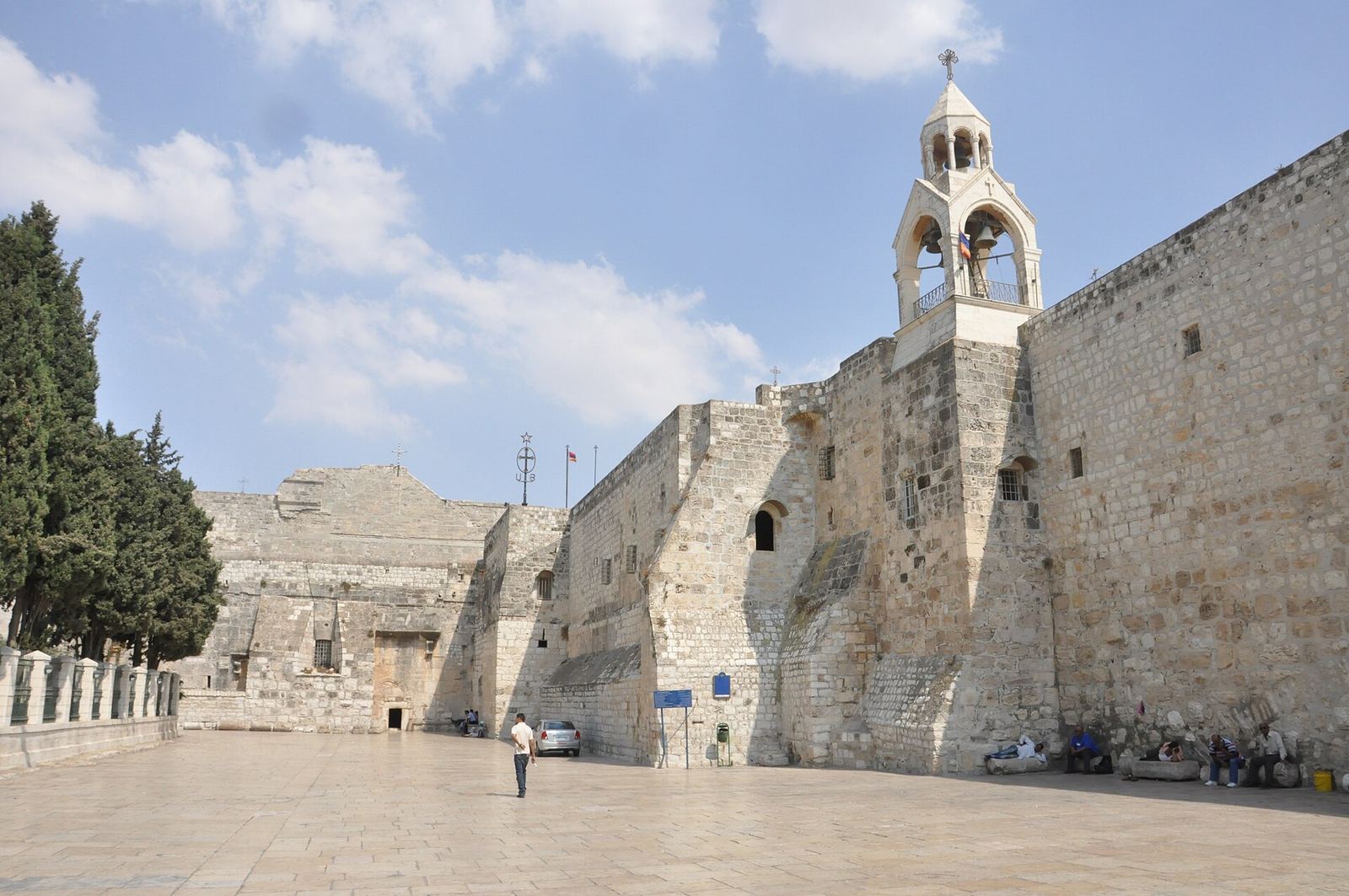
Place · Pilgrimage site
Church of the Nativity
The basilica over the cave venerated since early Christian times as the birthplace of Jesus; founded under Constantine and rebuilt under Justinian, and shared today by several churches.
- Location
- Bethlehem, West Bank
- Building
- Basilica over a grotto (shared by several churches; not a cathedral)
- Tradition
- Shared: Greek Orthodox, Roman Catholic (Franciscan Custody) and Armenian Apostolic
- Religious use
- In use by several churches under the Status Quo: the Greek Orthodox, Catholic (Franciscan) and Armenian communities, whose convents surround the basilica, hold rights in it and in the grotto.
- Official website
- No single official website: the basilica is shared under the Status Quo. The Custody of the Holy Land’s page (read here) describes the Catholic presence.
Map Building location: Apple Maps · Google Maps — the building, not a confirmed visitor entrance.
Overview
Christians have venerated a cave at Bethlehem as the place of Jesus’s birth since at least the third century, and pilgrims come above all to the Grotto of the Nativity beneath the choir.
History
Each paragraph says whether it is documented history, a tradition handed down, or disputed.
- Tradition
Matthew and Luke place Jesus’s birth in Bethlehem; the identification of this particular cave is early Christian tradition. The Custody of the Holy Land notes that Origen, in the third century, already knew of it, and that Hadrian had earlier built a shrine of Adonis over the site.
- Documented
Eusebius records that Constantine’s mother Helena dedicated a church “at the grotto which had been the scene of the Saviour’s birth”; according to the Custody, the work was finished by 333, when the Bordeaux pilgrim mentions it. After damage in the Samaritan revolt of the 520s, Justinian restored the church in the 530s. The 1907 Catholic Encyclopedia regarded the building as substantially Constantine’s with Justinian’s modifications; the extent of Justinian’s rebuilding is described differently in the sources read.
- Documented
Crusader-era restoration (1165–69) was paid for jointly by King Amalric I and the Byzantine emperor Manuel Comnenus. The Franciscans settled at Bethlehem in 1347. After changes in ownership in the seventeenth and eighteenth centuries (1757), an Ottoman firman of 1852 fixed the existing rights of the communities, the Status Quo.
Sources
Source-reviewed. Checked on 29 Oct 2026 against the sources marked “Read in a build session” with a passage named: the tradition of the grotto, the Constantinian foundation and later history (the Custody of the Holy Land, Eusebius, the 1907 Catholic Encyclopedia) and the Status Quo (the Custody). The UNESCO page for the site could not be read (refused); its inscription is not mentioned. Place names follow the Atlas’s neutral presentation for sensitive locations. This is a review of the statements named, not a verification of the whole site or of every tradition it describes.
Official source · Read in a build session
Bethlehem – Basilica of the Nativity — Custody of the Holy Land
Passage read: the history sections (Roman period to the Status Quo)
Read on 29 Oct 2026 from the copy fetched by the research workflow (research/fetched/pages/p-nativity/01). Supports: Origen; Hadrian’s shrine of Adonis; Helena and completion by 333 (the Bordeaux pilgrim); the Samaritan revolt and Justinian’s restoration (531); 1165–69; the Franciscans in 1347; 1757; the firman of 1852.
Primary source · Read in a build session
Life of Constantine, Book III — Eusebius of Caesarea — New Advent (Nicene and Post-Nicene Fathers translation)
Passage read: chapters 41–43
Read on 29 Oct 2026 from the copy fetched by the research workflow (research/fetched/pages/r2-nativity/01). Supports Helena’s dedication of a church at the grotto of the Nativity in Bethlehem.
Reference work · Read in a build session
Bethlehem — E. Arbez — The Catholic Encyclopedia (New York, 1907), via New Advent
Passage read: the paragraphs on the basilica and the grotto
Read on 29 Oct 2026 from the copy fetched by the research workflow (research/fetched/pages/p-nativity/03). A dated reference work. Supports: the building substantially Constantine’s with Justinian’s additions; the grotto beneath; the Latin, Greek and Armenian convents around it.