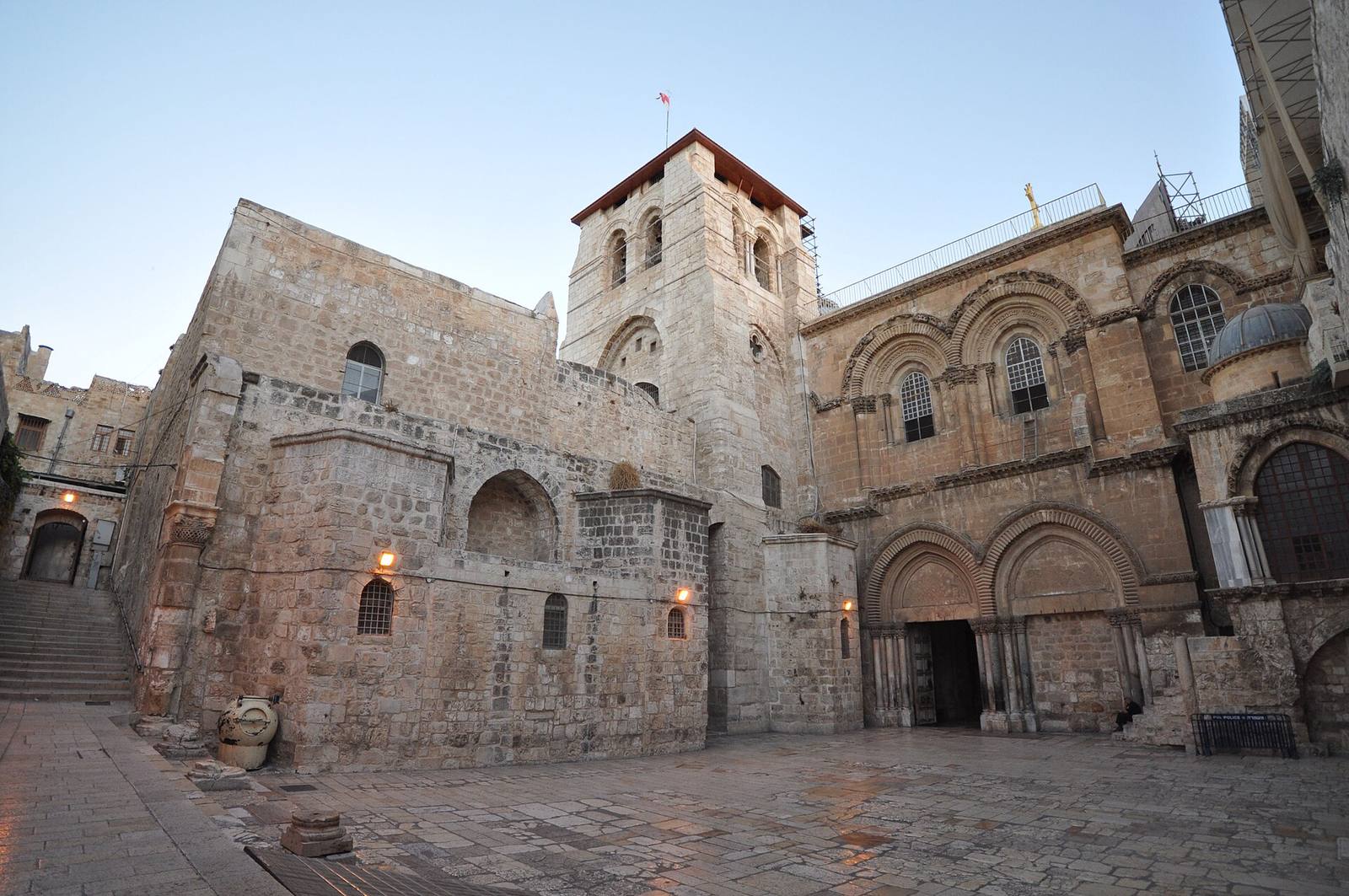
Place · Pilgrimage site
Church of the Holy Sepulchre
The church built over the places Christians have venerated since the fourth century as the site of Jesus's crucifixion and tomb.
- Location
- Jerusalem, Old City
- Building
- Church (shared by several churches; not a cathedral in the usual sense)
- Tradition
- Shared: Greek Orthodox, Roman Catholic and Armenian Apostolic, with Coptic, Syriac Orthodox and Ethiopian communities
- Religious use
- In use by several churches. The Greek Orthodox Patriarchate, the Franciscan Custody of the Holy Land (for the Catholic Church) and the Armenian Patriarchate hold the main rights; Coptic, Syriac Orthodox and Ethiopian communities hold more limited rights.
- Official website
- No single official website: the church is shared by several churches under the Status Quo, and each community has its own.
Map Building location: Apple Maps · Google Maps — the building, not a confirmed visitor entrance.
Overview
For most Christian traditions it is the holiest pilgrimage site in the world: it encloses the rock venerated as Golgotha and the Edicule over the tomb venerated as that of Christ. The church is shared, and its daily life is governed by a long-standing arrangement known as the Status Quo.
History
Each paragraph says whether it is documented history, a tradition handed down, or disputed.
- Documented
About 326 the emperor Constantine ordered a pagan temple on the site to be replaced by a church; it was consecrated on 13 September 335. Eusebius of Caesarea, a contemporary, describes the work.
- Tradition
The identification of the site with the crucifixion and burial of Jesus is ancient and was accepted by Constantine's builders; later tradition credits his mother Helena with finding the cross there. Archaeologists debate the identification, though many accept that the site lay outside the city walls in Jesus's time.
- Documented
The church was destroyed in 1009 on the orders of the Fatimid caliph al-Hakim, rebuilt by 1048, and remodelled after the crusaders took Jerusalem in 1099. The arrangement between the communities, the Status Quo, goes back to an understanding of 1757 and was fixed by an Ottoman decree of 1852–53.
Sources
Editorial draft. Some sources below were read (Wikipedia and Wikidata) and the text was corrected against them; others were located but could not be read, so the profile stays a draft.
Reference work · Located, not read
Holy Sepulchre — Encyclopaedia Britannica
Address confirmed on 28 Oct 2026 (it is indexed for this subject); the page itself could not be opened in this session, so no statement here has been checked against it.
Primary source · Located, not read
Life of Constantine, book 3, chapters 25–40 — Eusebius of Caesarea
The contemporary account of Constantine's building. Not read in this session.
Secondary study · Located, not read
Saving the Holy Sepulchre: How Rival Christians Came Together to Rescue Their Holiest Shrine — Raymond Cohen — Oxford University Press (2008)
For the Status Quo and the shared custody. Bibliographic details are not yet confirmed against a catalogue record, and the book has not been read for this profile.
Official source · Located, not read
Old City of Jerusalem and its Walls — UNESCO World Heritage Centre
Address confirmed on 28 Oct 2026 (it is indexed for this subject); the page itself could not be opened in this session, so no statement here has been checked against it.
Reference work · Read in a build session
Church of the Holy Sepulchre — Wikipedia (English)
Read on 28 Oct 2026 at revision 1382239358, fetched by the research workflow (research/fetched/places/church-of-the-holy-sepulchre/wikipedia.txt). A general reference work, not a scholarly source; the statements here were checked against it.
Reference work · Read in a build session
Wikidata item Q187702 (Church of the Holy Sepulchre) — Wikidata
Read on 28 Oct 2026: instance of, religion, diocese, coordinates and official website.