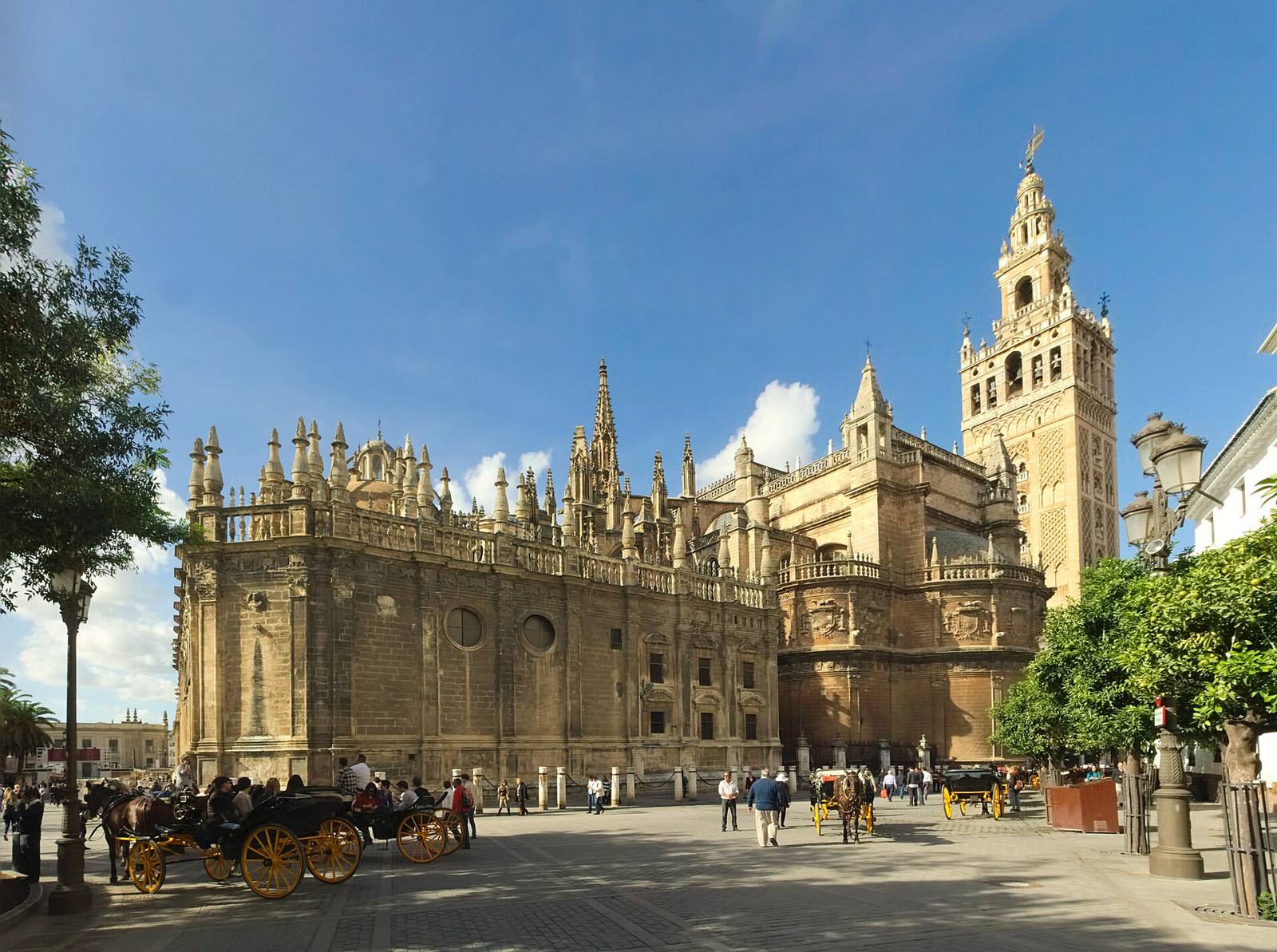
Place · Cathedral
Seville Cathedral
The largest Gothic cathedral, built on the site of the city’s twelfth-century great mosque, whose minaret became the Giralda.
- Location
- Seville, Spain
- Building
- Cathedral (archdiocesan see); built on the site of the Almohad great mosque
- Tradition
- Roman Catholic
- Religious use
- In use as the cathedral of the Archdiocese of Seville.
- Official website
- Seville Cathedral (official website, opens another site)
Map Building location: Apple Maps · Google Maps — the building, not a confirmed visitor entrance.
Overview
Seville Cathedral is one of the largest churches in the world and the largest Gothic cathedral. It was inscribed in 1987 as a UNESCO World Heritage Site with the Alcázar and the Archive of the Indies, and holds the tomb of Christopher Columbus.
History
Each paragraph says whether it is documented history, a tradition handed down, or disputed.
- Documented
The Almohad caliph Abu Yaqub Yusuf ordered a new great mosque for the city in 1172; it was dedicated in 1182. Shortly after Ferdinand III conquered Seville in 1248, the mosque was converted into the city’s cathedral.
- Documented
From 1401 it was replaced by the present Gothic cathedral, completed in 1506–07. Its royal chapel holds the remains of Ferdinand III and of his son Alfonso X.
Sources
Reference draft. The statements were checked against the general reference sources below, read in a build session (Wikipedia at a recorded revision, and Wikidata). They have not yet been checked against scholarly or primary sources.
Reference work · Read in a build session
Seville Cathedral — Wikipedia (English)
Read on 28 Oct 2026 at revision 1372575212, fetched by the research workflow (research/fetched/places/seville-cathedral/wikipedia.txt). A general reference work, not a scholarly source; the statements here were checked against it.
Reference work · Read in a build session
Wikidata item Q231606 (Seville Cathedral) — Wikidata
Read on 28 Oct 2026: instance of, religion, diocese, coordinates and official website.