Place · Pilgrimage site
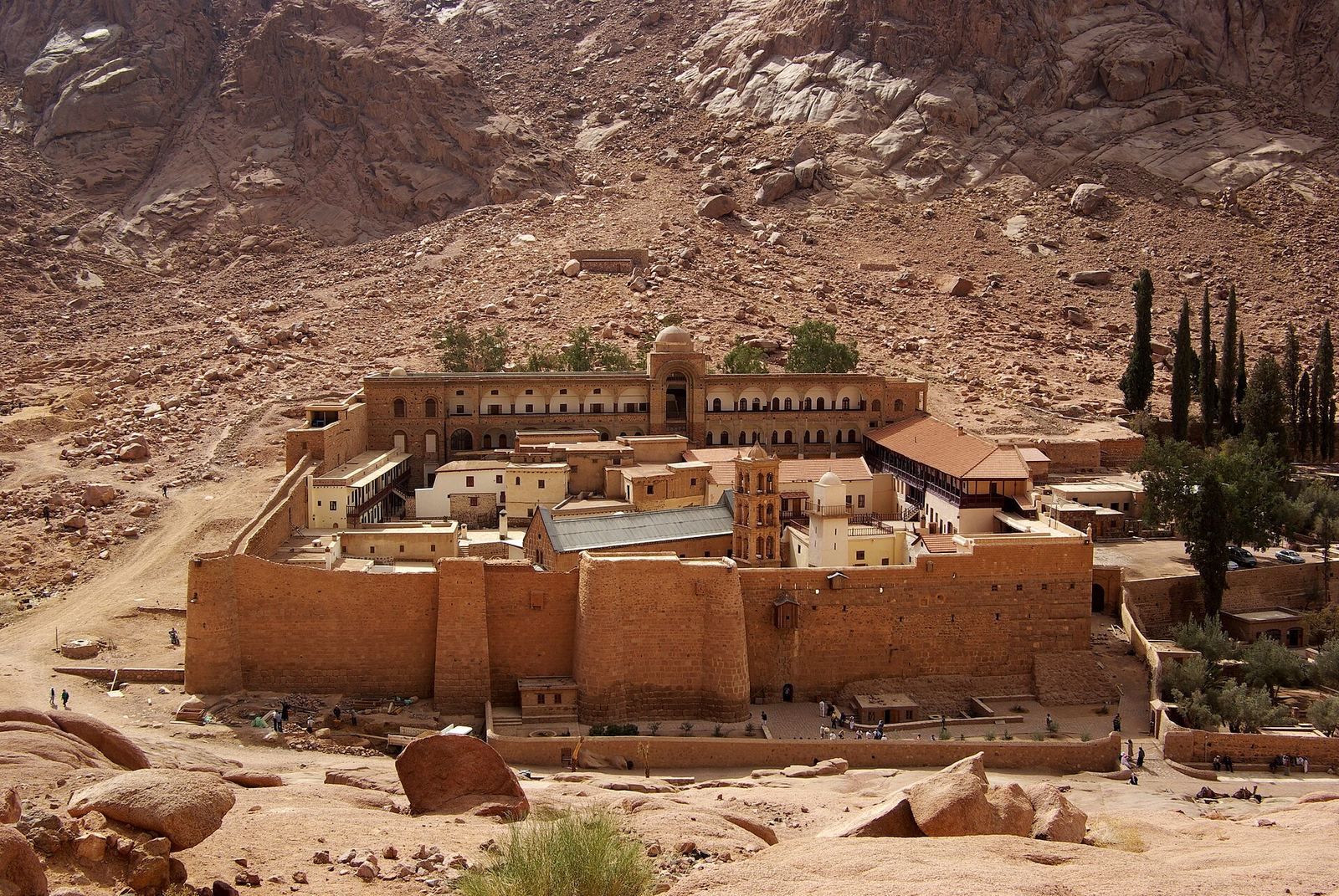
Saint Catherine’s Monastery, Sinai
Greek Orthodox monastery at the foot of the mountain identified in Christian tradition as Mount Sinai, built round the place venerated as that of the Burning Bush. Justinian built its church and fortress walls in the sixth century.
- Location
- Saint Catherine, South Sinai, Egypt
- Building
- Fortified Greek Orthodox monastery with a sixth-century basilica (not a cathedral)
- Religious use
- In use as a Greek Orthodox monastery of the autonomous Church of Sinai, which receives pilgrims and visitors.
- Map Not yet on the map: the OpenStreetMap search returned a different monastery about 2.4 km away, so no point could be confirmed.
Overview
Monks have lived here since late antiquity, and pilgrims have come since at least the fourth century to the place associated with Moses and the Burning Bush, and later to the relics of St Catherine of Alexandria. The monastery describes itself as the oldest continuously inhabited Christian monastery.
History
Each paragraph says whether it is documented history, a tradition handed down, or disputed.
- Tradition
Christian tradition identifies the mountain above the monastery as Sinai, where God appeared to Moses in the Burning Bush and gave the Law (Exodus 3 and 19–20), and venerates the place of the bush within the monastery. The relics of St Catherine of Alexandria, enshrined here, gave the monastery its common name.
- Documented
The monastery dates monastic life at Sinai from the third century, with hermits settled around the site of the bush, and the pilgrim Egeria, about 380, saw a church beside the bush. The historian Procopius records that Justinian built the monks a church dedicated to the Mother of God, “not on the mountain’s summit, but much lower down”, and a strong fortress with a garrison at the foot of the mountain.
- Documented
The monastery has kept its autonomy, confirmed by patriarchal decrees, and its Greek-speaking community, and it holds a document of protection that it attributes to Muhammad. It has been listed as a UNESCO World Heritage Site.
Sources
Source-reviewed. Checked on 29 Oct 2026 against the sources marked “Read in a build session” with a passage named: the tradition of the site, the early monks and Egeria, Justinian’s buildings (the monastery’s pages; Procopius) and the present community (the monastery). The identification of the mountain with the biblical Sinai is reported as tradition. UNESCO’s own page could not be read; the inscription year is not given. Added in place of Lalibela, whose scholarly sources could not be read this session. This is a review of the statements named, not a verification of the whole site or of every tradition it describes.
Official source · Read in a build session
The Holy Monastery of the God-trodden Mount Sinai — Saint Catherine’s Monastery, Sinai
Passage read: introduction
Read on 29 Oct 2026 from the copy fetched by the research workflow (research/fetched/pages/r4-sinai/01). Supports: Greek Orthodox; the site of the Burning Bush; the relics of St Catherine; “the oldest continuously inhabited Christian monastery” (its own claim); Greek-speaking community; listed by UNESCO.
Official source · Read in a build session
History — Saint Catherine’s Monastery, Sinai
Passage read: sections on monasticism, ancient prerogatives, Muhammad and pilgrims
Read on 29 Oct 2026 from the copy fetched by the research workflow (research/fetched/pages/r4-sinai/02). Supports: early anchorites at the bush; Justinian’s basilica and fortress; patriarchal decrees respecting its autonomy; the document of protection attributed to Muhammad; Egeria about 380.
Primary source · Read in a build session
Buildings, Book V — Procopius of Caesarea (tr. H. B. Dewing) — LacusCurtius (University of Chicago), Loeb Classical Library translation
Passage read: chapter 8 §§1–9
Read on 29 Oct 2026 from the copy fetched by the research workflow (research/fetched/pages/r4-sinai/03). Supports Justinian’s church of the Mother of God for the monks of Sinai, built low on the mountain, and the fortress with a garrison at its foot.