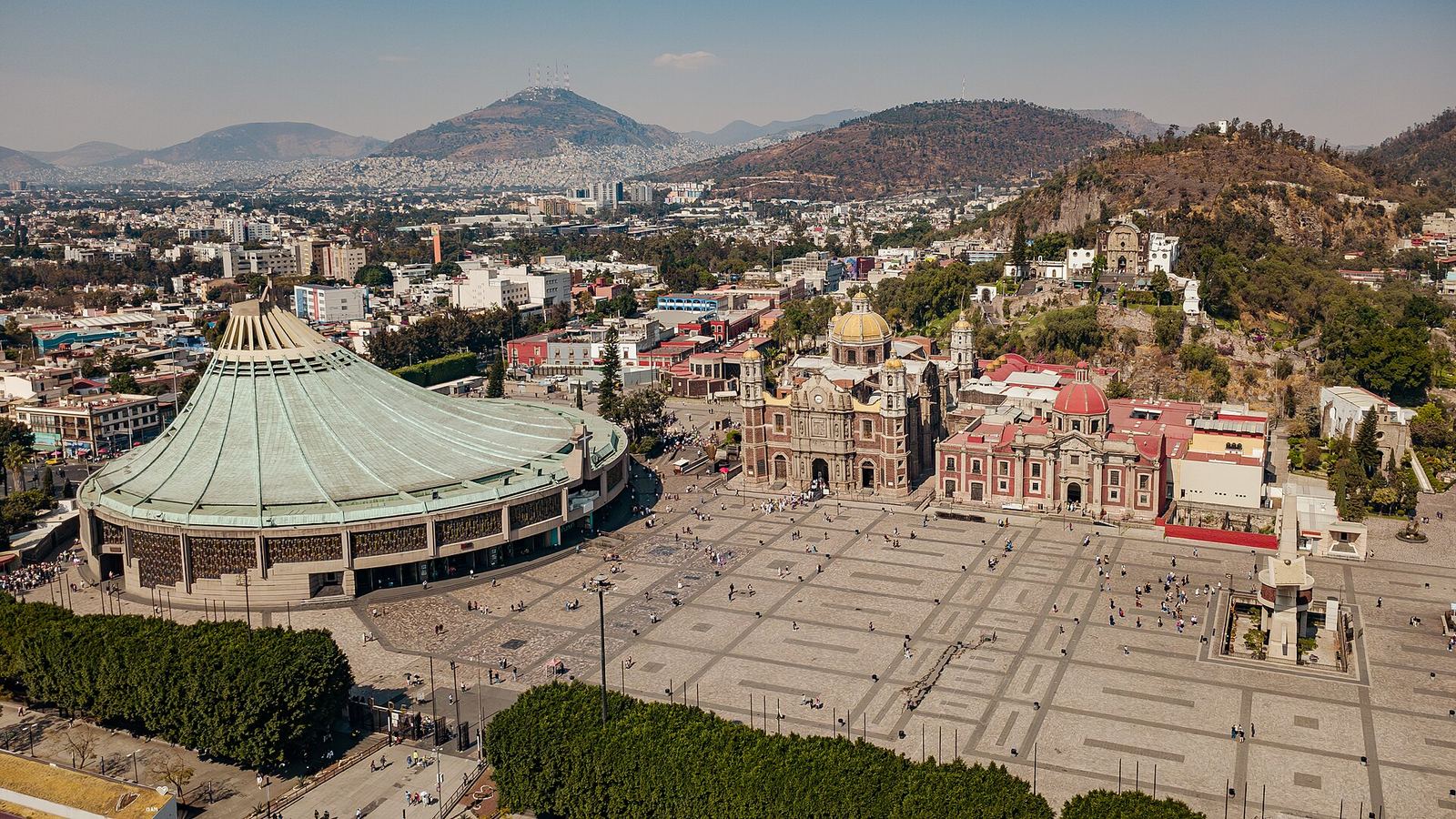
Place · Pilgrimage site
Basilica of Our Lady of Guadalupe
The sanctuary at the foot of Tepeyac hill that keeps the image of Our Lady of Guadalupe, associated with apparitions to Juan Diego in December 1531. The present basilica was dedicated in 1976 beside the basilica of 1709.
- Location
- Mexico City, Mexico
- Building
- Minor basilica and national sanctuary, with the old basilica beside it (not a cathedral)
- Tradition
- Roman Catholic
- Religious use
- In use as the national shrine of Mexico, governed by a chapter under a rector.
Map The new basilica: Apple Maps · Google Maps — this point within the site, not a confirmed visitor entrance.
Overview
Tepeyac has been a goal of pilgrims since the sixteenth century, from Mexico and the rest of the Americas. Pius X named Our Lady of Guadalupe patroness of Latin America in 1910, and John Paul II named her patroness of the Americas in 1999.
History
Each paragraph says whether it is documented history, a tradition handed down, or disputed.
- Tradition
According to tradition, in December 1531 the Virgin Mary appeared on Tepeyac hill to Juan Diego, a Nahua convert, and asked that a church be built; as a sign for Bishop Zumárraga, roses fell from his cloak, revealing the painted image. The main narrative, the Nican Mopohua in Nahuatl, is attributed to Antonio Valeriano.
- Disputed
The documentary basis is debated. The New Catholic Encyclopedia notes that no report by Zumárraga survives and probably none was written, and that the formal enquiry of 1666 came 135 years after the event and its references are “vague and rather weak”; it dates the Valeriano narrative to about 1560–70. The sanctuary’s historical institute regards the documents as confirming the event.
- Documented
A first hermitage was built about 1533, a larger church from 1556, and the basilica begun in 1695 was dedicated in 1709. The image was crowned in 1895. A new basilica was dedicated in 1976, and the Mexican bishops declared the sanctuary a national shrine in 1983. John Paul II canonised Juan Diego there on 31 July 2002.
Sources
Source-reviewed. Checked on 29 Oct 2026 against the sources marked “Read in a build session” with a passage named: the tradition, the debate on its documentary basis (New Catholic Encyclopedia; the sanctuary’s institute), the buildings, the national-shrine status and the 2002 canonisation. The apparitions are reported as tradition and their historicity as disputed. The supplied research’s claim that it is the most visited Catholic site in the Americas was not checked and is not repeated. This is a review of the statements named, not a verification of the whole site or of every tradition it describes.
Official source · Read in a build session
Síntesis de las Apariciones de la Virgen de Guadalupe a Juan Diego — Basílica de Santa María de Guadalupe
Passage read: whole page (in Spanish)
Read on 29 Oct 2026 from the copy fetched by the research workflow (research/fetched/pages/r2-guadalupe/01). Supports the traditional account of December 1531.
Official source · Read in a build session
Documentos Históricos — Basílica de Santa María de Guadalupe (Instituto de Estudios Teológicos e Históricos Guadalupanos)
Passage read: section on the Nican Mopohua (in Spanish)
Read on 29 Oct 2026 from the copy fetched by the research workflow (research/fetched/pages/r2-guadalupe/03). Supports the attribution to Antonio Valeriano and the institute’s view that the documents confirm the event.
Official source · Read in a build session
¿Quiénes Somos? — Basílica de Santa María de Guadalupe
Passage read: whole page (in Spanish)
Read on 29 Oct 2026 from the copy fetched by the research workflow (research/fetched/pages/r2-guadalupe/06). Supports pilgrimage since the sixteenth century; national shrine 17 November 1983; the statutes of 1998 (rector).
Official source · Read in a build session
50 Aniversario Basílica de Guadalupe 2026 — Basílica de Santa María de Guadalupe
Passage read: heading (in Spanish)
Read on 29 Oct 2026 from the copy fetched by the research workflow (research/fetched/pages/r2-guadalupe/05). Supports the fiftieth anniversary in 2026 of the dedication of the new basilica (1976).
Reference work · Read in a build session
Guadalupe, Our Lady of — New Catholic Encyclopedia (2nd ed., Gale, 2003), via Encyclopedia.com
Passage read: sections “Documentary Basis” and “Cult and Its Extension”
Read on 29 Oct 2026 from the copy fetched by the research workflow (research/fetched/pages/r3-guadalupe/02). A scholarly Catholic reference work. Supports the tradition, the documentary questions (Tovar summary, Valeriano relation c. 1560–70, no report by Zumárraga, the inquiry of 1666), the churches of c. 1533, 1556, 1695–1709, the coronation of 1895 and the patronages of 1910 and later.
Official source · Read in a build session
Canonization Mass of Blessed Juan Diego Cuauhtlatoatzin (31 July 2002) — Pope John Paul II — Holy See
Passage read: heading and §1
Read on 29 Oct 2026 from the copy fetched by the research workflow (research/fetched/pages/p-guadalupe/03). Supports the canonisation at the Basilica on 31 July 2002.